Mobile home transport escort requirements are the part of a move people underestimate until they see the line item — and the part that varies most between the two Carolinas. A manufactured home travels as an over-width load, which the law treats as a hazard to other traffic that has to be actively managed: warned ahead, flanked on the road, and routed around obstructions. That management is the escort's job, and both North Carolina and South Carolina require it — but they credential and deploy escorts differently, and a move that crosses the line has to satisfy both. Mobile Home Mover Pro builds the right escort plan into the quote rather than treating it as an afterthought.
What escorts actually do — and why width triggers them
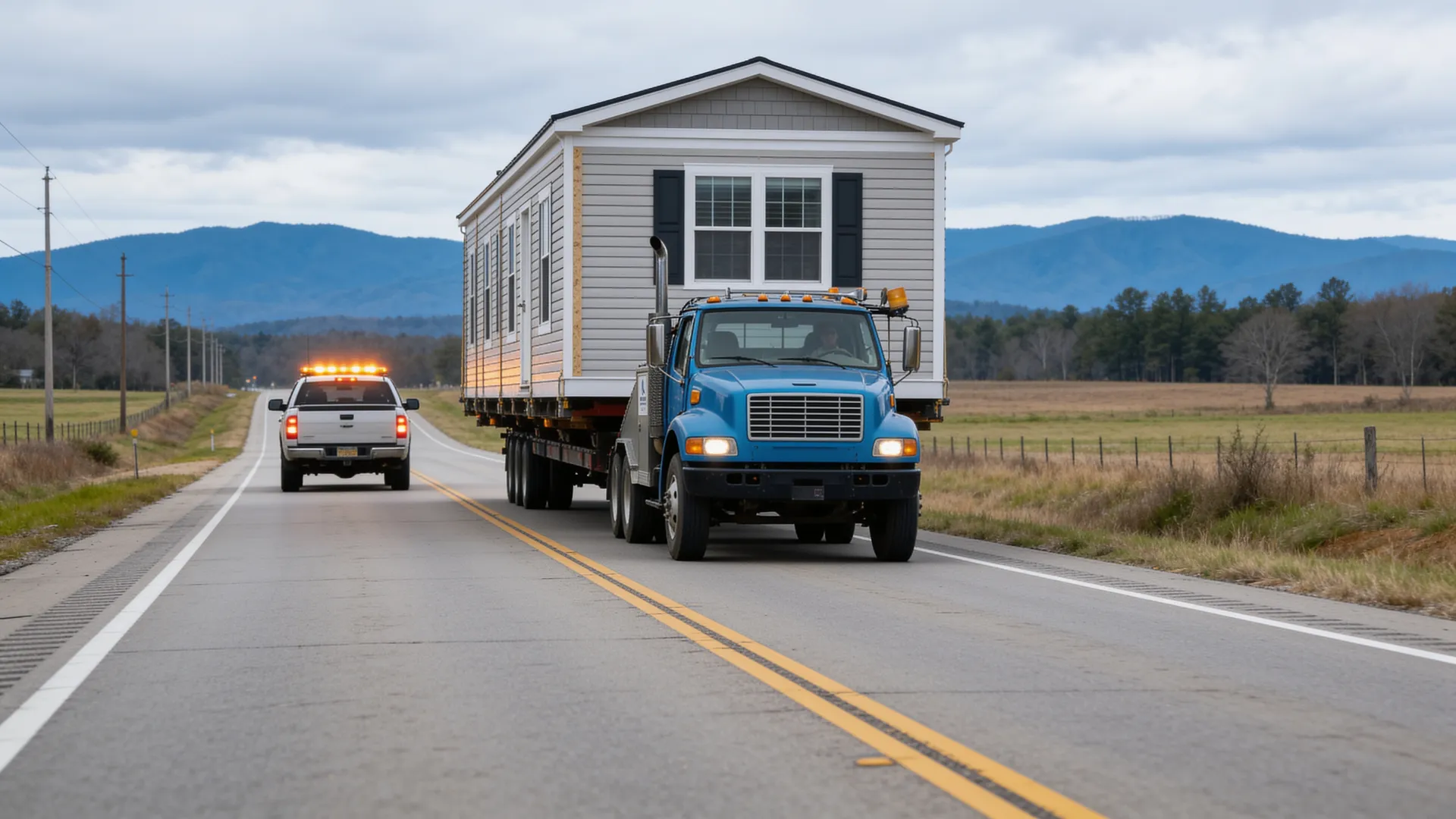
An escort vehicle isn't decoration; it's traffic control for a load that can take up most of a lane and then some. Escorts warn oncoming and following traffic with signage and amber lights, hold back vehicles trying to pass at the wrong moment, and — critically — run ahead of the load to confirm the route is clear of low bridges, tight overheads, and obstructions before the home reaches them. The trigger is width: the wider the load, the more escort coverage required. A standard single-wide typically needs at least one escort; wider single-wides and the individual halves of a double-wide can require both a front and a rear escort. Section count drives how many separate permitted trips you make — width drives how many escorts ride each one. The travel window itself is daylight-only and weather-restricted, with movement stopped when wind gusts climb past about 25 mph.
North Carolina: the certified EVO system
North Carolina doesn't let just anyone with a pickup run an escort on a manufactured-home move. The state requires NCDOT-certified Escort Vehicle Operators (EVOs) — drivers trained and credentialed under the state's EVO handbook — and the escort count and positioning are set by the NCDOT Publication MH-2 permit for the specific load. A certified EVO knows the signage and lighting rules, the traffic-management procedures, and how to clear the route — and using uncertified escorts can void the permit and the insurance on the move. It's one of the concrete things separating a licensed transporter from a cut-rate operator: the escort crew is a credentialed part of the job, written into the permit. The full NC permit chain is on our North Carolina mobile home moving laws page.
South Carolina: civilian escorts and the police-escort threshold
South Carolina runs a separate system. Ordinary over-width homes travel with civilian escort vehicles sized to the load under the state's oversize-movement rules, but South Carolina reserves a stricter measure for the widest loads, which can require a law-enforcement (police) escort instead of a civilian flag car. A required police escort reshapes the move: it has to be scheduled around the agency's availability, and it adds meaningful cost. That's a different model from North Carolina's certified-EVO approach, and it's why a transporter working both states plans the escort piece state by state rather than assuming one rule-book covers both. The wider SC framework — permits, severance, and setup licensing — is on our South Carolina mobile home moving laws guide.
Cross-state moves and what escorts cost
On a cross-state NC↔SC move, the two systems have to be reconciled: certified EVOs to North Carolina's spec on the NC leg, South Carolina's civilian-or-police escorts on the SC leg, and a clean handoff at the border on the same travel day. A single-state mover can't field compliant escorts on the other side of the line — the seam where cross-state moves come apart. On cost, escorts typically run a few hundred dollars per escort vehicle depending on distance and count, more when a police escort is required, and permits-plus-escorts together commonly land around 10–20% of a full move. We write the escort count into the quote for your exact width and route up front. Put the unit and the route on the form and Mobile Home Mover Pro returns the escort plan and price within 24 business hours — see the full cost to move a mobile home breakdown for where it lands.