Cross-state · Dual permits · NC ↔ SC · One carrier, border to border

Moving a Mobile Home Across State Lines (NC ↔ SC)

A North Carolina–to–South Carolina move has to clear two permit systems, two titling offices, and two escort rule-books on the same travel day. Here's the whole chain — and why one dual-state carrier is the difference between a clean move and a stalled one.

Licensed & insured · NC & SCNCDOT-certified escorts24-hour written quoteOne crew, start to finishPermits pulled in every county Licensed & insured · NC & SCNCDOT-certified escorts24-hour written quoteOne crew, start to finishPermits pulled in every county

Get a free quote

Back within 24 hours — no obligation.

Goes straight to our crew. We never sell or share leads.

Quick answer
Can a mobile home be moved across the NC–SC state line, and what does it take?
Yes. A cross-state NC↔SC move must satisfy both states at once: an NCDOT MH-2 oversize trip permit and an NCGS 105 county tax-paid permit on the North Carolina leg, and an SC § 31-17-360 county moving permit with treasurer tax-clearance on the South Carolina leg, plus a titling/severance step and escorts that honor each state's rules. Mobile Home Mover Pro holds authority in both states so one crew runs the home border to border.

Moving a mobile home across state lines between North Carolina and South Carolina is the most demanding move in the manufactured-housing world, and it's also the one with the least competition — because most movers hold authority in only one state and simply won't touch it. The Carolinas share a long border and an enormous amount of cross-line family, work, and land, so NC↔SC moves come up constantly: a home bought in Spartanburg headed for a family parcel near Hendersonville, a Pee Dee single-wide moving to the Sandhills, a coastal double-wide crossing from Horry County into Brunswick. Every one of them has to clear two of everything. Mobile Home Mover Pro carries operating authority and permits on both sides of the line, so your move never has to hand off at the border.

Two states, two permit chains, one travel day

The core difficulty is that a cross-state move doesn't replace one permit system with another — it stacks them. On the North Carolina leg you need the state oversize trip permit issued under the NCDOT Publication MH-2 rules — which set the legal daylight travel window, the 25-mph wind cutoff, the routing around low bridges, and the escort count — plus a county tax-paid moving permit under NCGS Chapter 105, Article 18. On the South Carolina leg, the county licensing agent issues the moving permit under SC Code § 31-17-360, and that statute won't let the permit issue until the county treasurer certifies the home's taxes are paid and the utilities are disconnected. Both regimes have to line up on the same approved travel day, which is the coordination an in-state move never has to think about. The full origin- and destination-state rule sets are broken out on our North Carolina mobile home moving laws and South Carolina mobile home moving laws guides.
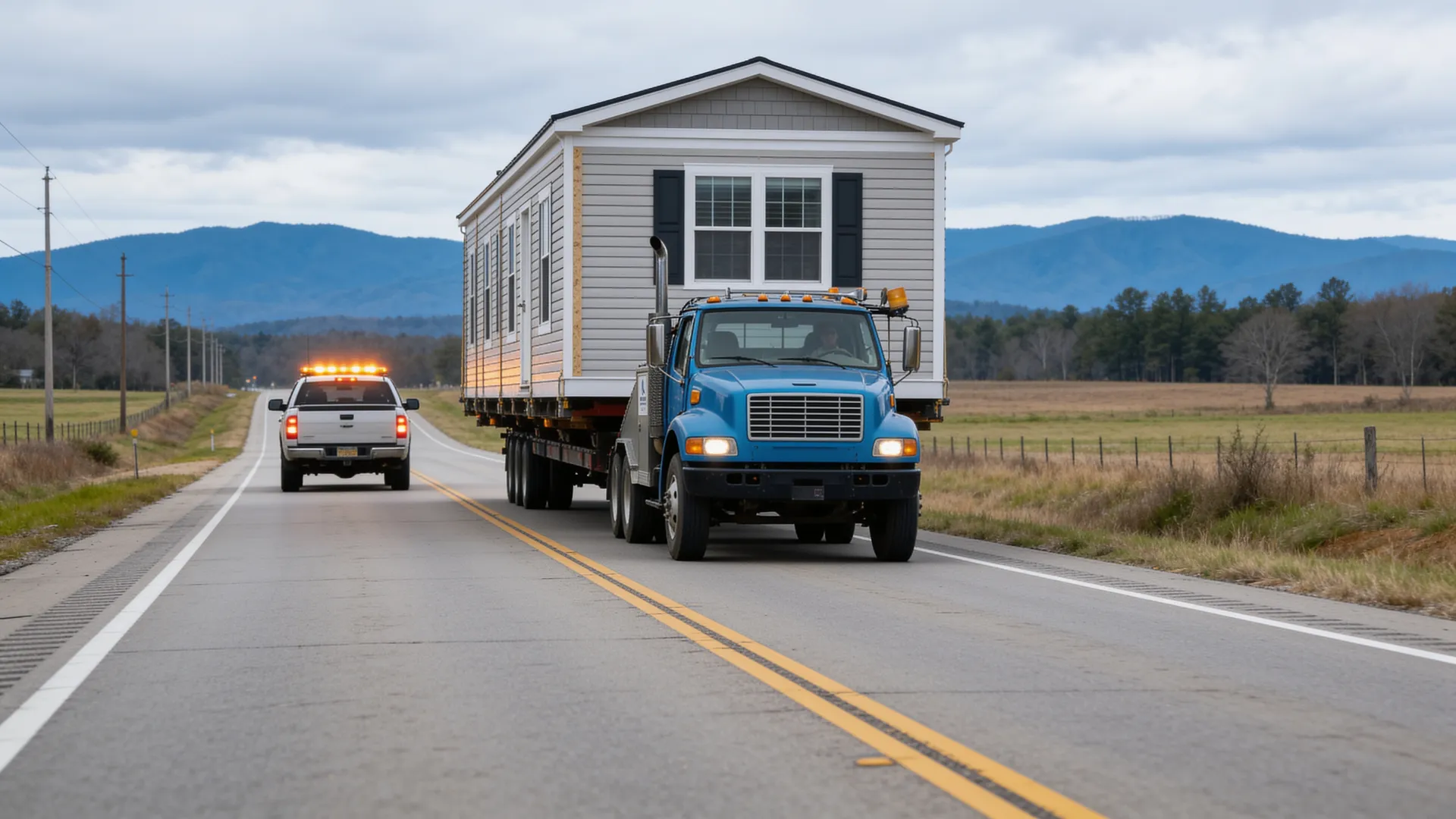
An oversize manufactured home crossing under escort on a Carolina highway
A NC↔SC move travels under permit and escort the whole way — one carrier owning the chain from border to border.

Titling: the home has to legally leave one state and arrive in the other

Permits get the home down the road; titling decides whether it can legally change states at all. Most settled manufactured homes have been detitled to the land — converted to real property — in their origin state, and a home titled to the land can't just be towed away. It has to be severed back to a movable title first, traveled, and then re-sited (and often re-detitled to the land) at the destination. South Carolina handles severance, the moving-permit decal, and the title action through § 31-17-360 and the SC DMV; North Carolina runs its version through the county tax office. The procedural detail — affidavits, forms, and which office signs off — is documented by the Manufactured Housing Institute of South Carolina. This is the step that most often stalls a cross-state purchase or refinance, so on a managed move the title chain is started the day the move is booked, not discovered the week of the haul.

Escorts across the state line

Both states require escort vehicles for an over-width manufactured home, but they don't run the same rule-book. North Carolina requires NCDOT-certified Escort Vehicle Operators, with the number of front and rear escorts scaling with the load's width under the MH-2 framework. South Carolina has its own escort requirements and, for the widest loads, can require a law-enforcement escort rather than a civilian one. On a NC↔SC move the escorts have to be arranged to satisfy whichever state the home is traveling through at each point and to hand off cleanly at the line — which only works when one carrier is coordinating both. The state-by-state escort thresholds are detailed on our mobile home transport escort requirements page.

Operating authority — the question behind the question

Underneath the permits sits a simpler legal fact: a carrier moving a home from one state into another is running an interstate move, which requires the right operating authority, not just a single-state setup license. A mover registered to work only inside South Carolina can't lawfully deliver a home into North Carolina, and vice versa. That's the real reason cross-state jobs get declined or handed off — and the reason the home's owner can end up holding the liability when an under-authorized mover crosses the line on an in-state permit. The federal framework for who may operate across state lines runs through FMCSA operating authority. We screen specifically for transporters who hold the authority and the permits to run NC↔SC legally.

Why one dual-state carrier is the whole answer

Stack it all up — two permit chains, two titling offices, two escort rule-books, interstate authority, and two county tax-clearance gates — and the single point of failure on a cross-state move is always the seam: the handoff between two companies that each own only half the job. A transporter holding authority and permits in both Carolinas erases that seam. One crew pulls the NC trip and tax permits, clears the SC § 31-17-360 permit, handles the severance and title action, books escorts to each state's spec, and keeps one chain of custody from the old pad to the new one. That's not a luxury on a NC↔SC move — it's the only way it goes right. Put your origin, destination, and unit type on the form and a licensed dual-state transporter prices the whole border-to-border move, permits included, within 24 business hours. If you're not sure your specific unit can make the haul at all, start with can a mobile home be moved.

Questions

Cross-state NC ↔ SC moves — straight answers

Can you move a mobile home from North Carolina to South Carolina (or back)?
Yes — but a NC↔SC move has to satisfy both states' rules end to end, and that's where most of them go wrong. On the North Carolina side you need an oversize trip permit under the NCDOT Publication MH-2 rules plus a county tax-paid moving permit under NCGS Chapter 105, Article 18. On the South Carolina side the county licensing agent issues a moving permit under SC Code § 31-17-360 only after the treasurer certifies taxes are paid. A mover has to hold the operating authority and the permits to cross the line legally. Mobile Home Mover Pro carries authority on both sides of the border so one crew owns the whole chain.
What makes a cross-state mobile home move harder than an in-state one?
Three systems double. Permits double — you file the trip and tax permits in the origin state and the moving permit in the destination state, and each has its own tax-clearance gate. Titling doubles — the home usually has to be cleared off the origin state's title or land record and re-titled or sited under the destination state's process, which in South Carolina means a severance/decal step and an SCDMV action. Escorts double — NC requires NCDOT-certified escort operators while SC runs its own escort and, for the widest loads, law-enforcement escort rules, and the two have to be coordinated across the state line on the same travel day. Any one of those handed off between two different movers at the border is where botched, half-permitted moves happen.
Do I have to retitle the mobile home when I move it to another state?
Almost always, yes. If the home was titled to the land (detitled as real property) in the origin state, it generally has to be severed back to a movable title before it can legally travel, then sited — and often re-detitled to the land — at the destination. South Carolina handles severance and the moving-permit decal under § 31-17-360 and through SCDMV; North Carolina runs its version through the county tax office. The mechanics of detitling and re-titling a manufactured home are laid out by the Manufactured Housing Institute of South Carolina. Getting the title step wrong is the most common reason a cross-state closing or financing stalls, so it's handled as part of pre-move staging, not after the haul.
How much more does it cost to move a mobile home across state lines?
The haul itself is priced on distance and sections like any move — roughly $3,000–$8,000 for a single-wide and $7,000–$15,000 for a double-wide in the regional range — but a cross-state move adds a second permit set, a second titling action, and escort coordination in two states, which typically lands the all-in 10–25% higher than a same-distance in-state move. The bigger swing is usually the tax-clearance gate in two counties rather than the permit fees themselves: a back-tax balance in either the origin or destination county freezes the move until it's settled. The full line-item breakdown is on our cost to move a mobile home guide.
Why does it matter that one carrier holds authority in both states?
Because the alternative is a seam in the middle of your move. A mover with authority in only one Carolina either declines a cross-state job or hands the home off at the line to a second company — and the moment two crews and two sets of paperwork are involved, the permit, escort, and travel-day coordination falls through the gap between them. A transporter holding operating authority and permits in both NC and SC files the origin-state trip and tax permits, the destination-state moving permit, books the escorts to each state's rules, and runs the home border to border with one chain of custody. That single-carrier control is the entire reason a NC↔SC move goes smoothly, and it's the specific gap Mobile Home Mover Pro screens for when matching your job.
Keep reading

Both states, end to end

Get a quote

Tell us about your move. We price it.

Unit, route, and timeline — that's all we need. Permits, NCDOT-certified escorts, and on-site setup are included in the quote, and you'll hear back within 24 business hours. We never sell or share your info.

Or call 24/7 — (828) 501-2670

Quote in 24 hours

Goes straight to our crew. We don't sell or share leads.